
How to Get Back on Track After Vacation (and Why Healthy Habits Fall Apart)
Nov 9, 2026 · @Martina Berger
I thought it would be easy to get back on track after vacation. I came home from Europe looking forward to my own bed, my kitchen, my dog and my healthy routine.
Instead, I felt sad and unmotivated. My morning walks? Gone. My protein breakfast? Missing, presumed dead. My exercise routine? Apparently still somewhere in Austria. A week later, only my weight had changed, and in the wrong direction.
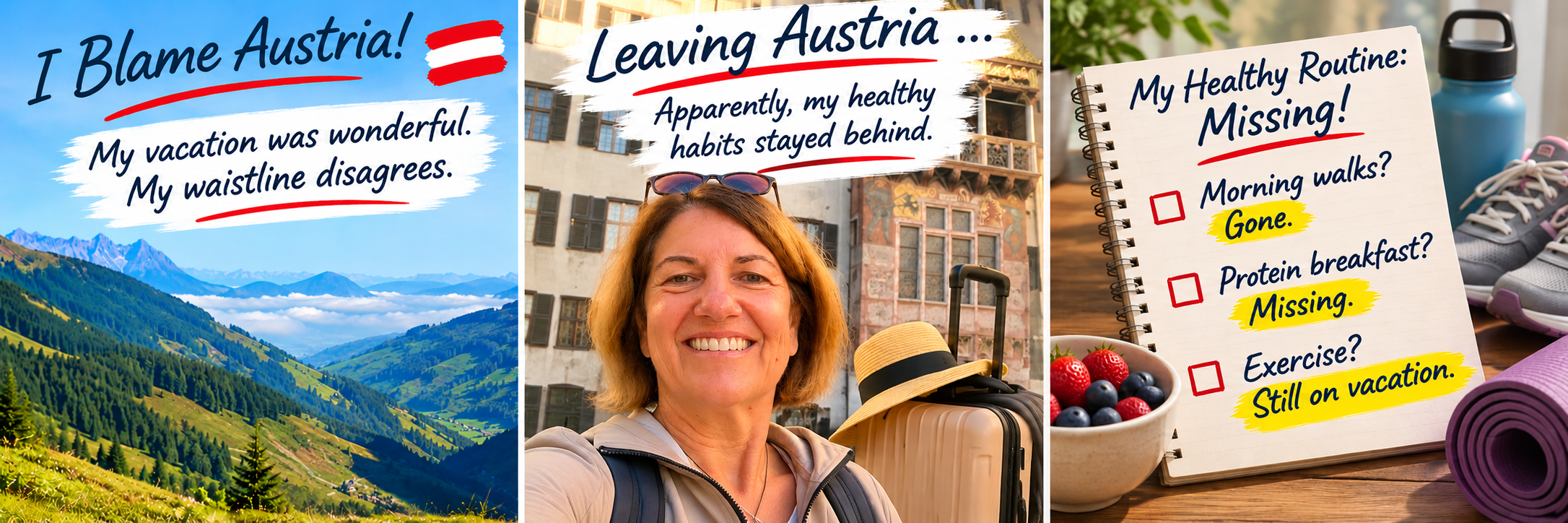
I wrote about this little disaster in my weight-loss blog, but the scientist in me wanted to know: why is it so easy to drop healthy habits on vacation, and so hard to get back on track after vacation?
With Thanksgiving and Christmas coming, consider this your early warning.
Why Coming Home Can Be Harder Than Leaving
Jessica de Bloom and colleagues (2010) found that the boost in well-being from a vacation fades quickly once people return to work. The holiday glow has a remarkably short shelf life.
On top of that, several psychological processes pile up:
Rewards and novelty. Vacations are full of new experiences and delicious food. Normal life feels dull by comparison. Suddenly, the refrigerator looks more exciting than the treadmill.
Environment. Wendy Wood and colleagues found that much of our daily behavior is habitual and tied to familiar surroundings. Change the surroundings, and the habits may go with them.
All-or-nothing thinking. One unplanned meal becomes a ruined day, a ruined day becomes a ruined week, and suddenly we're negotiating about starting fresh next Monday.
Emotions. Boredom, stress and returning responsibilities affect how we eat. Sometimes the problem isn't hunger at all.
Guilt. Instead of simply restarting, we criticize ourselves, which makes restarting even harder.
These processes feed each other. Before we know it, a wonderful vacation has turned into a psychological obstacle course.
So, Is It Really a Lack of Willpower?
Not necessarily. In a 2005 study, Wood and colleagues followed students who changed universities. Their habits were more likely to continue when familiar cues stayed in place. When the cues changed, behavior became less automatic.
So a healthy routine isn't only a daily test of willpower. It's also about creating conditions that make healthy behavior easier. We don't need to become more disciplined or more miserable. We need to give our brains a little help finding their way home.
Mine apparently needs GPS.
How to Get Back on Track After Vacation
Put the walking shoes back by the door.
Fill the refrigerator with food that supports your goals.
Restart one familiar activity instead of reorganizing your entire existence by Monday morning.
Remember that one imperfect day doesn't erase months of progress.
Of course, knowing what to do and actually doing it are two very different things. Which brings us to the really interesting psychology.
Going Deeper: Three Traps That Keep Us Stuck
The "I'll Start Monday" Trap: how one bad day becomes a bad week.
The Guilt Paradox: why beating yourself up doesn't help you lose weight.
Are You Hungry, or Just Avoiding Your Life?: when food is really an escape from boredom, anxiety or an unpleasant task.
Because the hardest part of weight loss isn't always knowing what to eat. Sometimes it's understanding why we do everything except what we planned.
Scientific References
de Bloom, J., et al. (2010). Effects of vacation from work on health and well-being: Lots of fun, quickly gone. Work & Stress, 24(2), 196–216.
Wood, W., Quinn, J. M., & Kashy, D. A. (2002). Habits in everyday life: Thought, emotion, and action. Journal of Personality and Social Psychology, 83(6), 1281–1297.
Wood, W., Tam, L., & Witt, M. G. (2005). Changing circumstances, disrupting habits. Journal of Personality and Social Psychology, 88(6), 918–933.
This article is for general information, combining scientific findings with personal observations. It is not medical advice.